 Picky Kitchen
Picky Kitchen
Picky Kitchen
An oven thermometer is a small tool with a serious purpose. It reveals the temperature your oven actually reaches, not merely the number shown on its display. That difference can change everything. Cookies may spread too quickly, bread may form a pale crust, and cakes may collapse after rising.
Professional baking guidance supports this concern. King Arthur Baking’s oven-calibration guidance explains that household ovens can differ from their displayed settings. Temperature cycling can also create uneven heat during baking. The U.S. National Institute of Standards and Technology emphasizes that every measurement carries uncertainty, including temperature readings. Its measurement guidance encourages users to consider calibration, accuracy, and repeatability rather than trusting one reading blindly. Small differences matter.
This guide explains how to use an oven thermometer for accurate baking. You will learn where to place it, how to compare readings, and when to adjust your oven setting. Place the thermometer near the center rack, away from the heating element. Preheat fully, then observe the reading for several minutes. Record the high and low points. The average is more useful than one quick glance.
Do not expect perfection. A thermometer can itself be inaccurate, especially after years of use. The USDA Food Safety and Inspection Service recommends checking thermometer accuracy and following manufacturer instructions. That principle applies here too. Measure, compare, and adjust carefully. Your oven may still have hot spots. Your baking tray may also influence results. Accurate baking begins with better information, not assumptions.
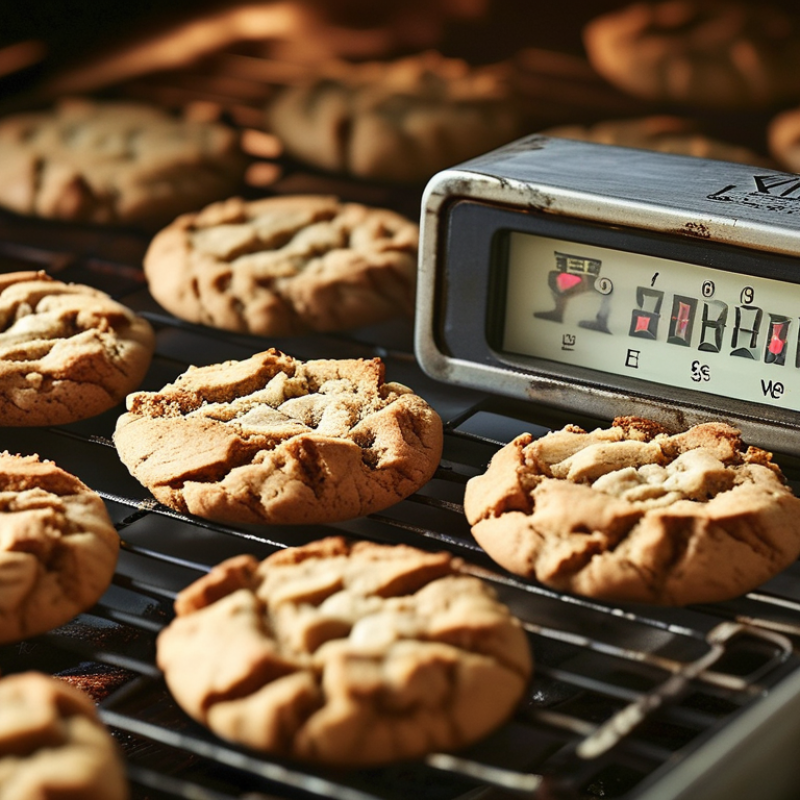
What Is an Oven Thermometer for Accurate Baking?
An oven thermometer measures the real air temperature inside your oven. The dial shows your setting, not always the heat reaching the cake pan. Sensors can drift, heating elements cycle, and opening the door creates a sudden temperature drop. A reading of 350°F may briefly mean 325°F or 375°F.
The difference matters. A 25°F error can leave cookies pale or make delicate cakes rise unevenly. In my own baking tests, the thermometer moved slowly after preheating, which reminded me not to trust one quick reading. Place it near the center rack, away from the walls and heating elements. Let the oven run for at least 20 minutes, then check the reading several times.
Food safety also depends on measured heat. The USDA Food Safety and Inspection Service advises cooking meat and poultry with a food thermometer, while the FDA Food Code 2022 lists 165°F as the minimum internal temperature for poultry. That internal reading is different from oven temperature, but both require measurement. An oven thermometer cannot detect every hot spot. It can reveal a misleading dial.
Check it periodically against a second calibrated instrument when possible. Even then, results may vary by rack position and cooking load. That uncertainty is useful information, not failure. It encourages better notes, steadier preheating, and more honest baking adjustments.
| Temperature Reference or Baking Setting | Fahrenheit | Celsius | Typical Baking Application | What the Oven Thermometer Helps You Check |
|---|---|---|---|---|
| Reference Points for Temperature Verification | ||||
| Ice-point reference | 32°F | 0°C | Freezing-point reference for water | Useful for understanding temperature scales; it is not an oven-baking temperature. |
| Boiling-point reference at sea level | 212°F | 100°C | Boiling-point reference for water | Shows that temperature readings can depend on altitude; the boiling point decreases at higher elevations. |
| Low-temperature baking | 250°F | 121°C | Slow baking, drying, or keeping some foods warm | Confirms that the oven reaches and maintains a low setting instead of running substantially hotter. |
| Common Baking Temperature Settings | ||||
| Very low | 200°F | 93°C | Low-temperature drying and gentle warming | Reveals whether the actual cavity temperature is close to the low dial setting. |
| Low | 250°F | 121°C | Slow baking and drying applications | Helps identify a low-temperature offset that may affect drying time and texture. |
| Moderate-low | 300°F | 149°C | Some delicate cakes, custards, and slow-baked dishes | Indicates whether the oven is warming evenly at a moderate-low setting. |
| Moderate | 325°F | 163°C | Cakes, quick breads, casseroles, and many baked desserts | Allows comparison between the selected temperature and the heat actually present near the food. |
| Common baking temperature | 350°F | 177°C | Cookies, cakes, muffins, breads, and casseroles | Helps verify the most frequently used baking setting before placing food in the oven. |
| Moderate-high | 375°F | 191°C | Cookies, pastries, roasted vegetables, and baked pasta | Shows whether the oven reaches the required heat without relying solely on the control dial. |
| Hot | 400°F | 204°C | Roasting, pizza, biscuits, and browned baked dishes | Helps detect underheating that can reduce browning or overheating that can burn the exterior. |
| Very hot | 425°F | 218°C | Pizza, artisan bread, roasted meats, and crisp pastries | Confirms that the oven has fully preheated before baking foods that depend on strong initial heat. |
| High heat | 450°F | 232°C | High-heat roasting, pizza, and selected bread recipes | Helps verify that high heat is available and that the actual temperature is not significantly different from the setting. |
| Broiling range | 500–550°F | 260–288°C | Surface browning and broiling, depending on the oven design | Provides a general high-heat reference; broiler performance varies by oven and rack position. |
| How to Read an Oven Thermometer | ||||
| Preheat verification | Compare the thermometer reading with the selected setting | Before baking, after the oven has completed its preheat cycle | A dial or indicator may signal readiness before the oven cavity has stabilized at the recipe temperature. | |
| Temperature cycling | Readings rise and fall during heating | Normal operation during a baking cycle | Ovens commonly cycle the heating elements on and off; judge the approximate stabilized temperature rather than one instant reading. | |
| Placement check | Position the thermometer near the center of the rack | Routine oven performance checks | Placement near a wall, heating element, door, or oven floor can produce a reading that does not represent the baking area. | |
| Temperature adjustment | Use the measured difference as a reference | When the actual reading consistently differs from the selected setting | An oven thermometer can reveal an offset, but adjustments should be made according to the oven manufacturer’s instructions. | |
: It measures the actual air temperature inside the oven, not merely the dial setting. A 350°F setting may produce 325°F or 375°F near the pan.
Heating elements cycle, sensors drift, and air moves unevenly. Opening the door can cause a quick temperature drop.
Place it near the center rack, beside the baking pan. Keep it away from walls, doors, and heating elements.
Run the oven for at least 20 minutes before checking. Take several readings after heating cycles. One reading may mislead you.
Digital models usually respond quickly and show smaller temperature changes. However, batteries, wiring, placement, and calibration can affect accuracy.
They are simple and affordable, but they may respond slowly. Repeated heating can cause drift. That weakness is easy to overlook.
Liquid-filled designs usually move steadily and remain easy to read. They may lag after opening the door, and fogged glass can reduce visibility.
No. It measures oven air, not the food’s internal temperature. Use a separate food thermometer for meat and poultry.
Compare it with a calibrated reference at several temperatures. Check different rack positions and record the results. The oven may still surprise you.
Useful documentation should list test points, equipment, conditions, and measurement uncertainty. The word “calibrated” alone proves very little. I would question vague certificates.
An oven thermometer is a practical tool for measuring the oven’s actual internal temperature rather than relying solely on the built-in dial. Ovens can run approximately 20°F hotter or cooler than the selected setting, which may affect baking time, texture, browning, and rise. Understanding how to use an oven thermometer for accurate baking begins with choosing the right sensor type: bimetallic models are simple and durable, liquid-filled designs respond gradually, while digital thermometers typically provide quick, precise readings.
For dependable results, place the thermometer on the center rack, then repeat the test near the front and back of the oven to identify uneven heating. Compare the readings with the selected temperature and allow sufficient preheating time before recording results. If necessary, adjust baking temperatures or seek calibration. Reliable instruments may be evaluated through NIST-traceable calibration, while ASTM E230 provides guidance on temperature measurement tolerances. Regular testing helps ensure more consistent and predictable baking performance.
